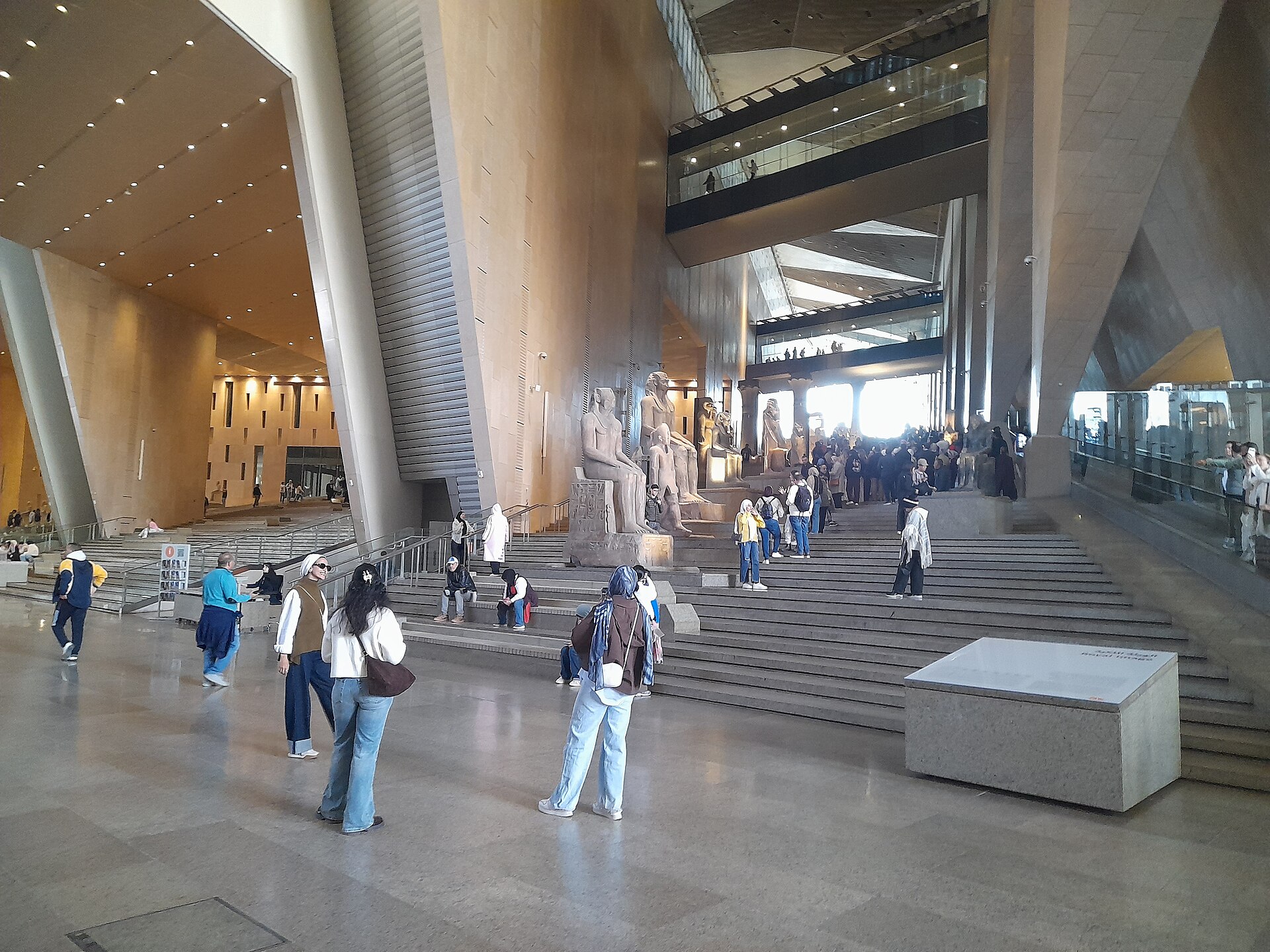
The Grand Egyptian Museum — GEM, as almost everyone now calls it — is the largest archaeological museum ever built. Its construction, first announced in the late 1990s, has stretched across five Egyptian presidencies, three architectural competitions, two revolutions, and a pandemic. The complex opened in phased stages from 2023 onwards, with the full Tutankhamun galleries becoming accessible to the public in 2024 and the institution's grand inauguration taking place in late 2025. Seen from a distance on the Giza Plateau, its pale limestone walls cut a clean diagonal line that echoes, deliberately, the slope of the Great Pyramid a kilometre to the east.
This article is a guide to what the Grand Egyptian Museum is, how it is organised, what is worth seeing, and how to think about its relationship with the older museum in Tahrir Square.
A project more than twenty years in the making
An international design competition for the museum was announced by the Egyptian government in 2002. More than 1,500 entries were received from 83 countries — at the time, it was the largest architectural competition in modern history. The winning scheme came from the Dublin-based practice Heneghan Peng, whose proposal organised the building around a long diagonal spine aligned with the pyramids of Khufu, Khafre, and Menkaure. The idea was that a visitor passing through the museum's atrium would see the pyramids framed at the end of the axis — and, consciously or otherwise, understand the museum as a preface to the monuments themselves.
Construction began in 2005, and the project was expected to be completed by 2013. Political upheaval, economic volatility, and the sheer complexity of moving tens of thousands of objects — many of them large and fragile — delayed the opening by more than a decade. The final construction cost, funded in large part through a concessional loan from Japan's JICA, is estimated at just over one billion US dollars.
The site: architecture and scale
The museum occupies some 480,000 square metres on a plateau at the edge of the Giza complex, roughly two kilometres from the Great Pyramid. The main building covers about 92,000 square metres, making it the single largest museum dedicated to one civilisation in the world.
The architectural gesture that matters most is the one immediately experienced by every visitor. The front façade is an immense translucent wall — a surface of alabaster panels fitted into a triangulated steel frame — that filters the Cairo sun and casts a honey-coloured light into the entrance hall. A grand staircase ascends through the full height of the building, lined on both sides by a chronological installation of colossal royal statuary. At the top of the staircase, visitors emerge onto a terrace that looks out, unobstructed, at the Giza pyramids.
Architectural critics have compared the effect to the approach to the Acropolis or to the new museum at the foot of Athens's sacred rock. The analogy is apt: both buildings are designed to bring the visitor into a particular emotional state before the monument itself is approached. In that sense, GEM is not a rival to the pyramids. It is their antechamber.
The Tutankhamun galleries
The defining achievement of the Grand Egyptian Museum is the installation of the complete Tutankhamun collection — approximately 5,400 objects — on public display for the first time in history. At the old Egyptian Museum in Tahrir, only about a third of the material discovered by Howard Carter in 1922 could ever be shown at any one time, for reasons of space.
At GEM, the Tutankhamun galleries occupy a dedicated suite of rooms arranged to recreate the sequence of the original tomb: antechamber, annex, burial chamber, treasury. Visitors move through the space in the order in which Carter and his team encountered the objects. The outer gilded shrines — which could never be assembled in Tahrir — have been reconstructed in their full nested configuration. The gold funerary mask is displayed alone in a dedicated chamber, in low light and behind non-reflective glass.
The effect, for visitors who remember the old Tutankhamun rooms in Tahrir, is transformative. Objects that were previously seen in dense jewel-case crowding — the canopic shrine, the chariots, the wooden figures of gods — now have breathing room. Conservation condition, long a source of anxiety, is dramatically improved: climate-controlled cases, inert display materials, and controlled light levels mean that the collection is now presented under conditions equal to or better than those of any comparable European or North American museum.
Other galleries
The Tutankhamun material is the headline, but it is not the whole of the museum. The main chronological galleries, arranged across the building's upper floors, trace Egyptian civilisation from the Predynastic period through the Graeco-Roman era. Highlights include:
- The 11-metre-tall statue of Ramesses II that stood for decades in the square outside Cairo's main railway station before its celebrated relocation in 2006. It now serves as the centrepiece of the museum's atrium.
- The solar boat of Khufu, a 43-metre wooden vessel recovered from a pit beside the Great Pyramid in 1954. Its transfer to the new museum in 2021 was a logistical and engineering operation of remarkable precision.
- A dedicated children's museum on the lower level, designed in consultation with education specialists.
- A specialised Conservation Centre, partly visible to the public, where the museum's in-house team works on objects both from the permanent collection and on loan from other Egyptian institutions.
How GEM relates to the other museums
The opening of the Grand Egyptian Museum has re-drawn the map of museum-going in Egypt. The country now has three principal institutions in and around Cairo:
- The Egyptian Museum in Tahrir, which retains the bulk of the non-Tutankhamun pharaonic material and a century of curatorial history.
- The Grand Egyptian Museum, which holds the Tutankhamun collection, large-scale statuary, and a comprehensive chronological display at modern curatorial standards.
- The National Museum of Egyptian Civilization (NMEC) in Fustat, which houses the Royal Mummies Hall and a thematic display covering the full sweep of Egyptian history from prehistory to the present.
None of these is a substitute for the others. A thorough visitor to Cairo should allocate time to all three, and indeed part of what makes the current moment in Egyptian museum culture so interesting is that — for the first time in its modern history — the country has a museum infrastructure proportionate to the scale of what it is showing.
Practical notes
GEM is located on the Giza Plateau, approximately two kilometres from the pyramids themselves. Tickets are sold online and at the museum entrance; separate tickets are required for the main museum and the Tutankhamun galleries. The museum is open daily with extended evening hours on select days, and multi-hour visits are recommended — most visitors we have spoken to find that a first visit of four hours still leaves much unseen. On-site facilities include cafés, a bookshop, and a dedicated visitor centre. Shuttle connections to the pyramid complex itself are operated by the museum.
For a first visit, our editors suggest beginning on the Grand Staircase (the statuary gallery), proceeding through the chronological rooms, and finishing with the Tutankhamun suite. The sequence respects the building's internal logic and saves the most intense experience for last.
A closing note
The Grand Egyptian Museum is a building designed to be seen once, twice, and then many times — a place that rewards repeated visits. It is also, importantly, an Egyptian institution: designed by architects working in collaboration with Egyptian authorities, curated by Egyptian Egyptologists, and opened under Egyptian direction. For more than a century, the canonical display of Egyptian antiquities has been distributed across the museums of London, Paris, Berlin, Turin, and New York. With GEM, the centre of gravity of pharaonic display has returned decisively to Egypt itself — and specifically to the foot of the plateau where the culture it represents took its earliest monumental form.

Karim El-Sayed
Karim is a former field archaeologist who worked on excavations in Saqqara and Luxor before turning to journalism. He covers museum openings, restoration projects, and institutional policy.
More from our archive
 Cairo
Cairo
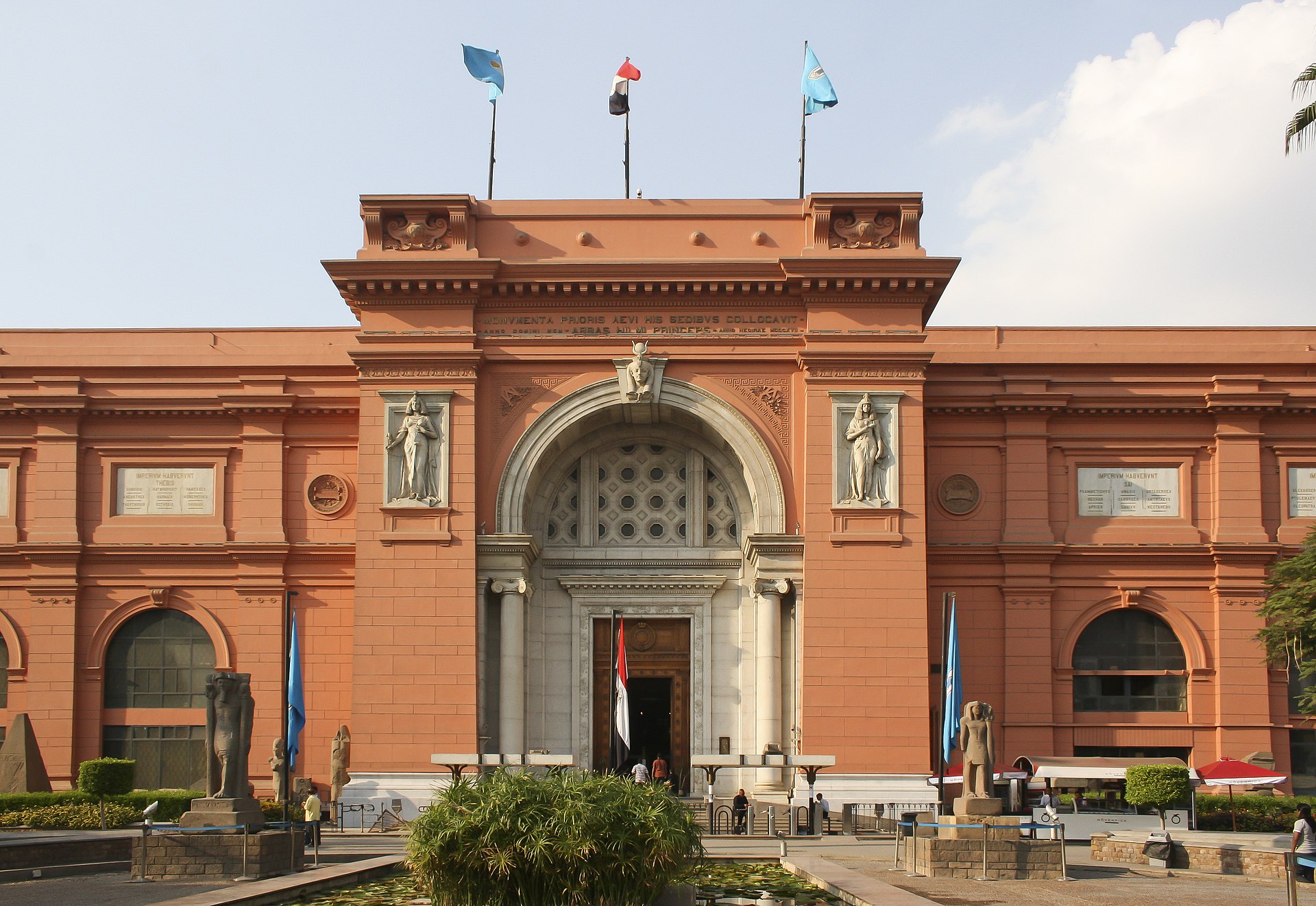
The Egyptian Museum in Cairo: A Journey Through 120 Years of History
Founded in 1902, the Tahrir Square institution holds the world's largest collection of pharaonic antiquities. A look at its architecture, its most iconic halls, and what remains after the Tutankhamun collection moved to GEM.
 Cairo
Cairo
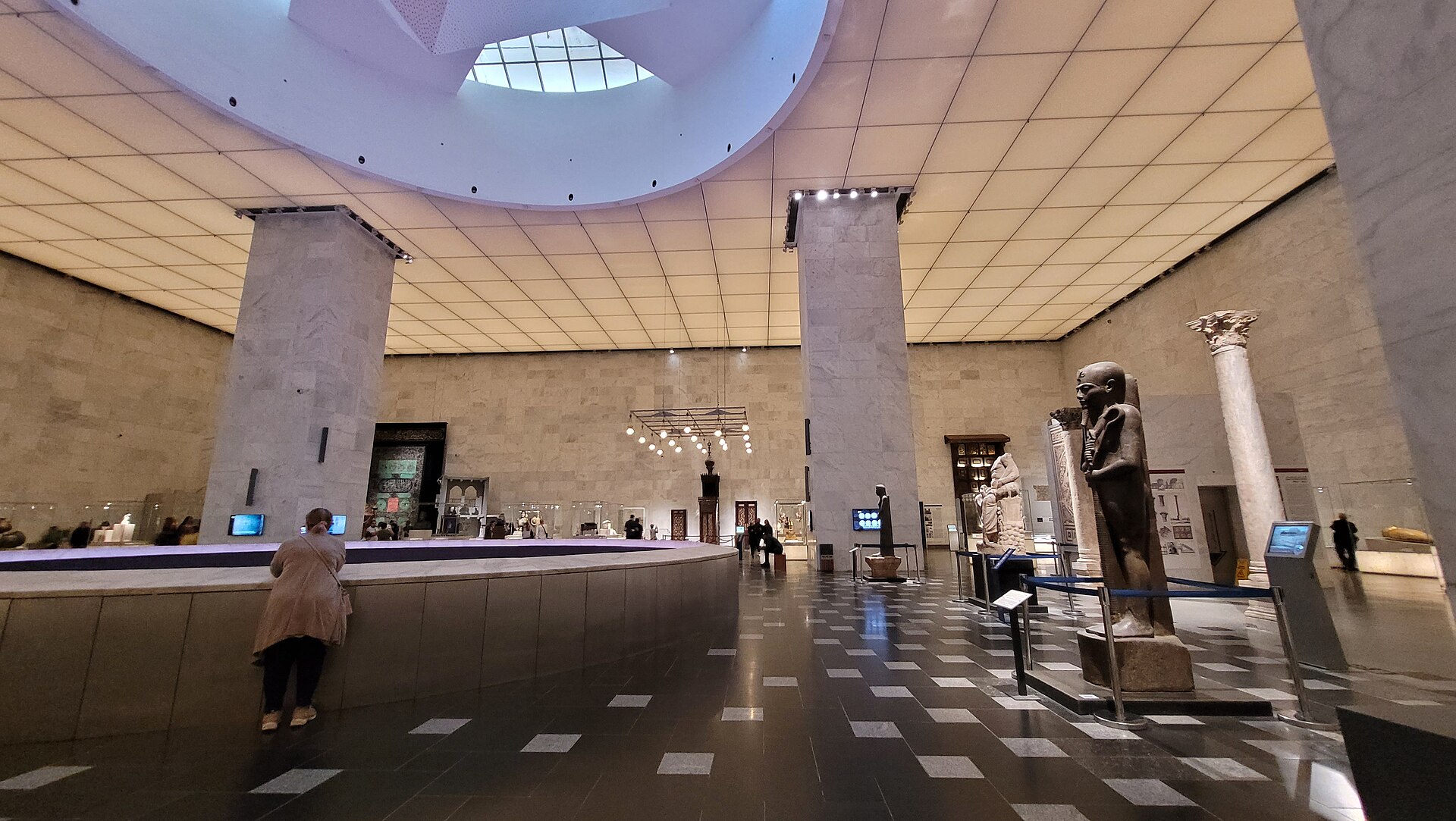
The National Museum of Egyptian Civilization (NMEC): From Prehistory to Modernity
The NMEC in Fustat is the only Egyptian institution telling the full national story — from prehistoric settlements to contemporary Egypt. Its Royal Mummies Hall, the 2021 Pharaohs' Golden Parade, and what makes its curatorial approach distinctive.
 Luxor
Luxor
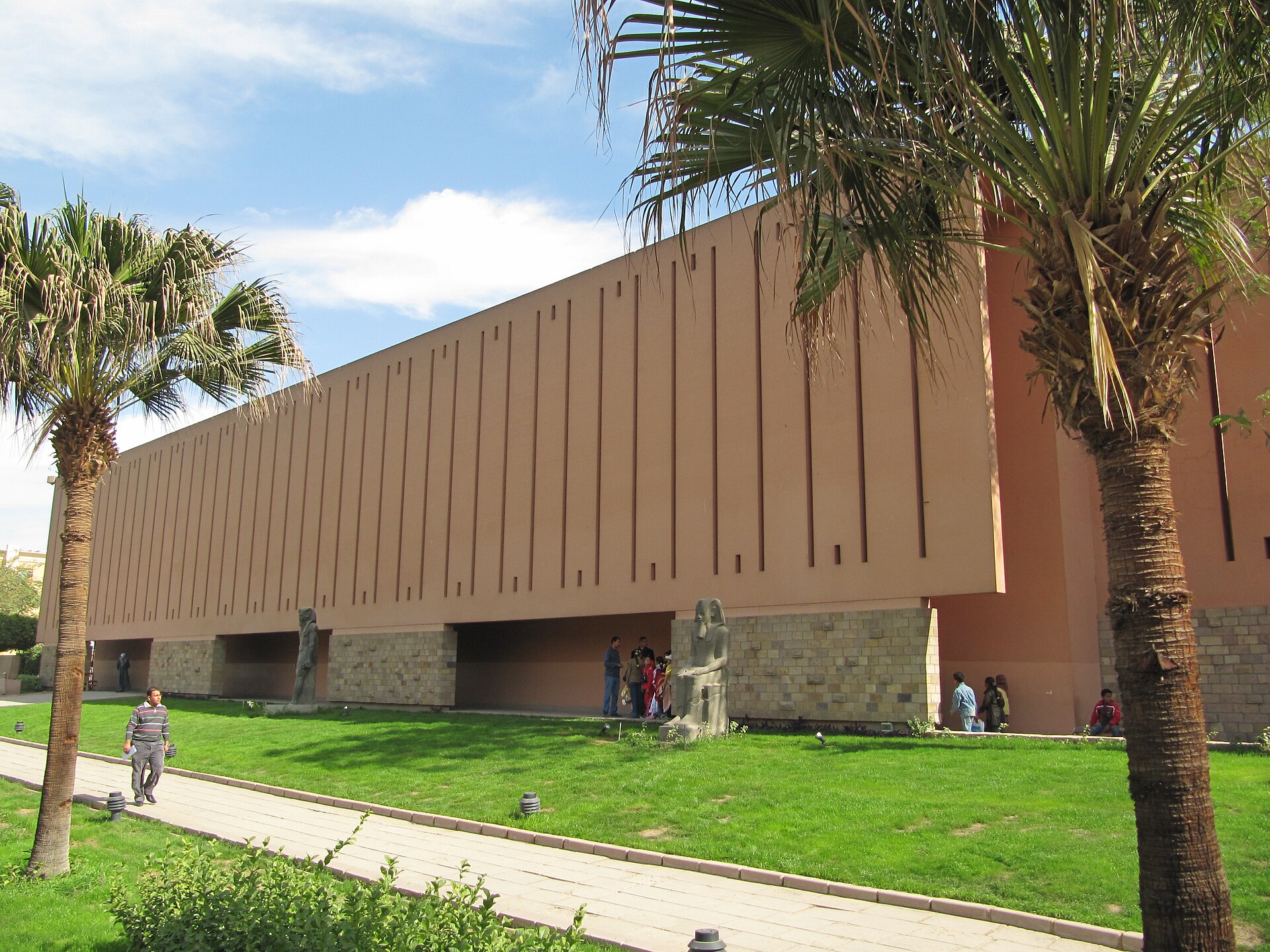
Luxor Museum: The Heart of Ancient Thebes
Opened in 1975 on the east bank of the Nile, the Luxor Museum is deliberately small and deliberately curated. A guide to its two royal mummies, the Karnak Cachette finds, and why many Egyptologists consider it the country's most elegant display.