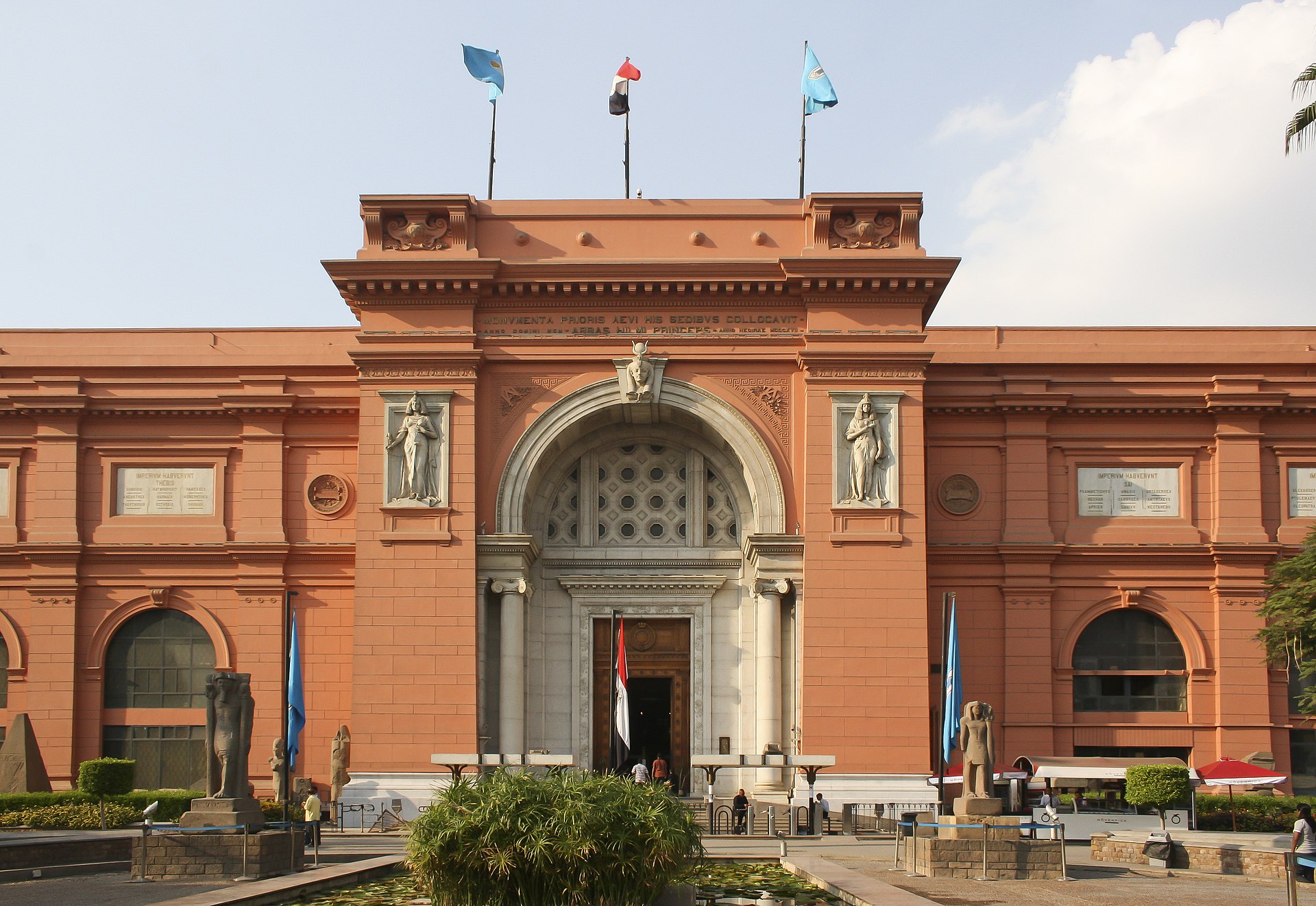
Few institutions in the world have shaped the public imagination of ancient Egypt as thoroughly as the Egyptian Museum in Cairo. For more than a century, the neoclassical building on the north side of Tahrir Square has been the first and often only place where visitors to the country encountered the material remains of the pharaonic past at scale. Its salmon-pink façade, flanked by sphinxes and framed by royal palms, is as recognisable as any monument on the Giza Plateau itself. And yet, in the past three years, the museum has quietly undergone the most significant transition in its history — one that is reshaping what it is, what it shows, and why it remains worth visiting even after the arrival of its vastly larger successor across the Nile.
This is a guide to the museum as it stands today: its history, its architecture, the collections that remain on display in Tahrir, and what the Egyptian Museum is becoming now that the Tutankhamun material has moved to the Grand Egyptian Museum on the Giza Plateau.
Origins: from Boulaq to Tahrir
The museum traces its origin to 1858, when the French Egyptologist Auguste Mariette persuaded the Egyptian government to establish a state antiquities service and a central collection in Boulaq, on the east bank of the Nile. Mariette's warehouse in Boulaq became, in effect, the first public museum of Egyptian antiquities on Egyptian soil — a response to decades of uncontrolled export of pharaonic material to the museums of Europe. A flood of the Nile in 1878 damaged the Boulaq collection, which was subsequently moved to a wing of the Khedival palace in Giza. Only in 1902 did the collection reach its permanent home on the north side of what is now Tahrir Square.
The new building was the result of an international competition won in 1895 by the French architect Marcel Dourgnon. Dourgnon's design — a two-storey neoclassical palace with a central rotunda, a symmetrical plan, and a pale pink exterior in keeping with the European museum vocabulary of the period — was a deliberate statement. Egypt's antiquities, the architecture implied, deserved a building of the same monumental ambition as the Louvre or the Altes Museum in Berlin. When it opened on 15 November 1902, the institution was officially named the Musée des Antiquités Égyptiennes and quickly became known, as it is today, simply as the Egyptian Museum.
Architecture: a building that tells its own story
Much of the Tahrir building's charm lies in the fact that it has changed very little in more than a hundred and twenty years. Visitors entering under the neoclassical portico pass into a tall central atrium from which two floors of galleries unfold in a symmetrical ground plan. On the ground floor, the collection is organised roughly chronologically, with the earliest material — Narmer Palette, Old Kingdom statuary — closest to the entrance. The upper floor is organised thematically: royal mummies, everyday life in ancient Egypt, models from the tomb of Meketre, and so on.
The display cases themselves are part of the history. Many of the wooden cabinets, with their etched-glass doors and brass fittings, are the original furniture of the 1902 installation. The handwritten labels, some of which survive alongside more recent typewritten and printed cards, are a reminder that the museum is, in a sense, a museum of the early-twentieth-century museum — a snapshot of how Egyptologists of that period chose to present the pharaonic past.
That quality has made the building itself a subject of growing interest. A multi-year conservation programme, supported in part by the European Union, has been restoring galleries, installing climate control in priority rooms, and digitising parts of the collection. The work is proceeding gallery by gallery and is expected to continue into the late 2020s.
Collections on display today
The most common question readers ask is whether the Tahrir museum is worth visiting now that the Tutankhamun collection has moved to the Grand Egyptian Museum. The answer is unambiguously yes. The Egyptian Museum still holds more than 150,000 objects, and even after the transfer of the Tutankhamun material — roughly 5,000 pieces — the collection that remains is richer than any other pharaonic museum in the world outside of Egypt.
Among the highlights still on view in Tahrir:
- The Narmer Palette, a ceremonial slate palette dating to around 3100 BCE, is among the earliest historical documents of a unified Egyptian state. Its depictions of a king wearing the white and red crowns have been interpreted as a record of the unification of Upper and Lower Egypt.
- The statues of Rahotep and Nofret, from Meidum, are painted limestone seated figures of a Fourth-Dynasty prince and his wife. Their inlaid eyes — rock crystal set in copper rims — produce the slightly unsettling sense of being watched that generations of visitors have remarked on.
- The Meketre tomb models, discovered by the Metropolitan Museum's expedition in 1920, are miniature wooden tableaux of a Middle-Kingdom nobleman's estate: a brewery, a bakery, a butcher's shop, a reviewing stand with cattle. They remain among the most immediate windows onto daily life in the second millennium BCE that any museum possesses.
- The Amarna collection — colossal statues of Akhenaten, the unfinished head of Nefertiti known as the 'Berlin double' counterpart, and the sunk-relief talatat blocks from the dismantled temples at Karnak — continues to anchor the upper-floor galleries.
- The Fayum mummy portraits, naturalistic painted panels attached to mummies in the Roman period, bridge pharaonic funerary tradition and Graeco-Roman portrait painting.
What has moved, and what remains
The transfer of the Tutankhamun material to the Grand Egyptian Museum took place in stages between 2020 and 2024, concluding with the relocation of the gold funerary mask itself. The Royal Mummies Hall, which once held the mummies of Ramesses II, Seti I, and other New Kingdom rulers, was emptied in April 2021 when the mummies were moved in a televised procession — the Pharaohs' Golden Parade — to the National Museum of Egyptian Civilization in Fustat. A small number of royal mummies still reside at Tahrir in a separate hall, but the most iconic pieces are now at NMEC.
What this means in practice is that the Tahrir museum today is a quieter, less crowded, and in many ways more contemplative place than it was a decade ago. Visitors who remember the Tutankhamun galleries of the 2010s describe the experience as a relief. The Amarna rooms, the statuary of the Middle Kingdom, and the Fayum portraits can now be studied without the pressure of moving with a crowd.
Practical notes for visitors
The museum is open daily, and current opening hours are published on the Ministry of Tourism and Antiquities' official channels. An adult ticket for foreign visitors costs in the range set by the ministry and is subject to periodic revision. Photography without flash is generally permitted in the main galleries, though a separate ticket is required for the Royal Mummies Hall. Guided tours in multiple languages can be arranged at the entrance. The museum is accessible by metro (Sadat station, directly under Tahrir Square) and is within walking distance of the Nile Corniche.
Our editors recommend setting aside at least three hours for a first visit, and ideally a full morning. The building is not air-conditioned throughout, and summer visits are most comfortable in the early hours. A second visit, if your itinerary allows, is often rewarding: the collection is large enough that individual rooms repay close attention, and the museum has a way of looking different at different times of day as the Cairo light moves through its high windows.
Why the Tahrir museum still matters
There is a temptation, now that the Grand Egyptian Museum has opened with its spectacular architecture and its complete Tutankhamun installation, to regard the old Tahrir building as a kind of appendix — a historical curiosity to be visited after the main event. In our view, that reading is mistaken.
The Egyptian Museum in Tahrir is the only major pharaonic collection in the world that preserves the texture of a late-Victorian museum installation. Its rooms have been walked through by Howard Carter, by Jean-François Champollion's intellectual descendants, by every generation of Egyptologists for more than a century. Its labels, its light, and its very silence carry a specific kind of historical weight that the newer, more technologically sophisticated institutions cannot reproduce. For a serious visitor, the two museums are not substitutes; they are complements. The Grand Egyptian Museum offers scale and presentation. The Tahrir museum offers depth, continuity, and the quiet authority of an institution that has been doing this work, in essentially the same form, since 1902.

Mariam Fahmy
Mariam holds an MA in Egyptology from the American University in Cairo and has written about museum culture for regional publications since 2014. She leads our Cairo coverage.
More from our archive
 Giza
Giza
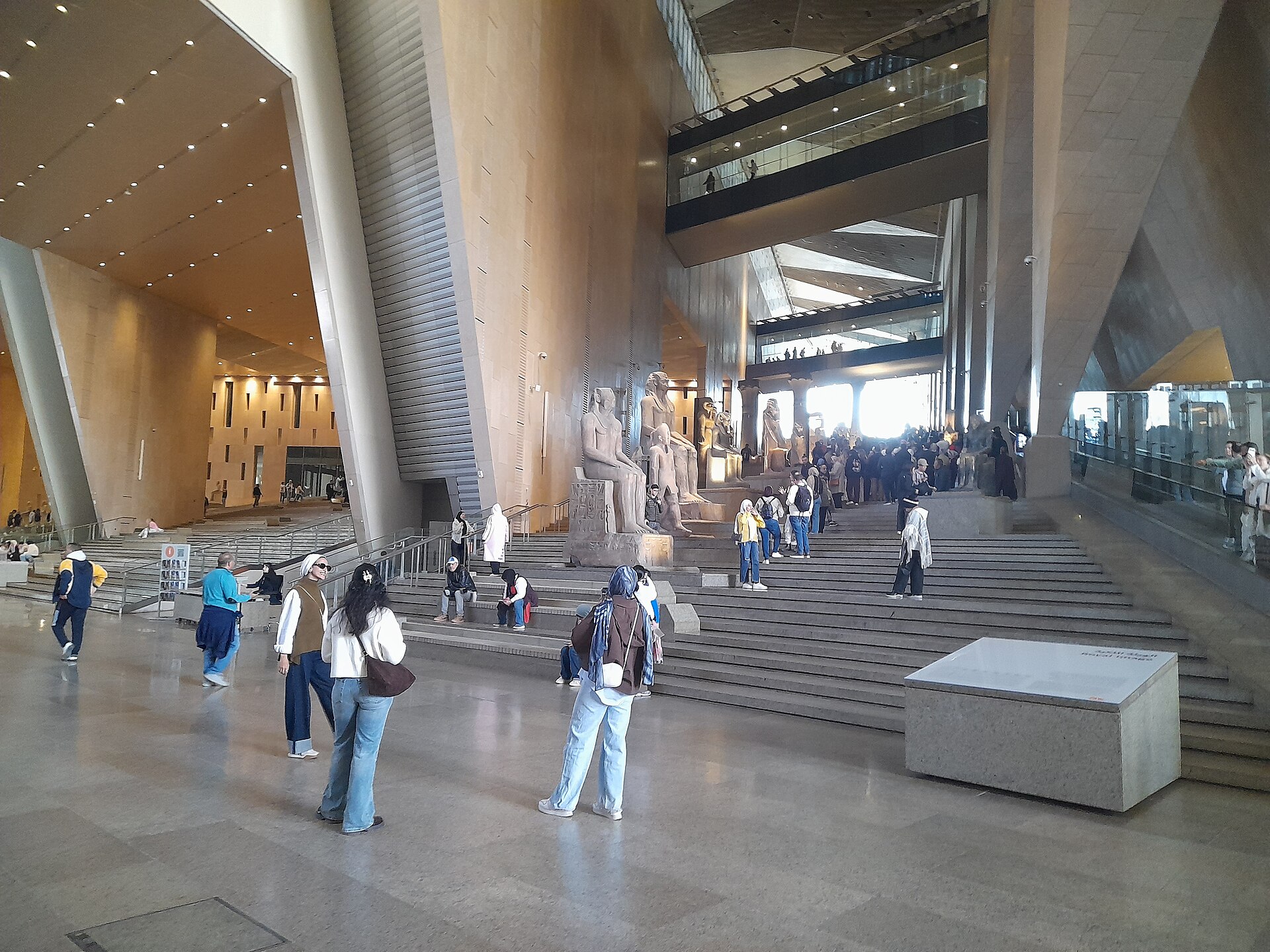
The Grand Egyptian Museum (GEM): The World's Largest Archaeological Complex
After more than two decades in the making, the Grand Egyptian Museum near the Giza Plateau is now the defining institution for the pharaonic era. Inside its halls, its scale, and the full Tutankhamun collection on public display for the first time.
 Cairo
Cairo
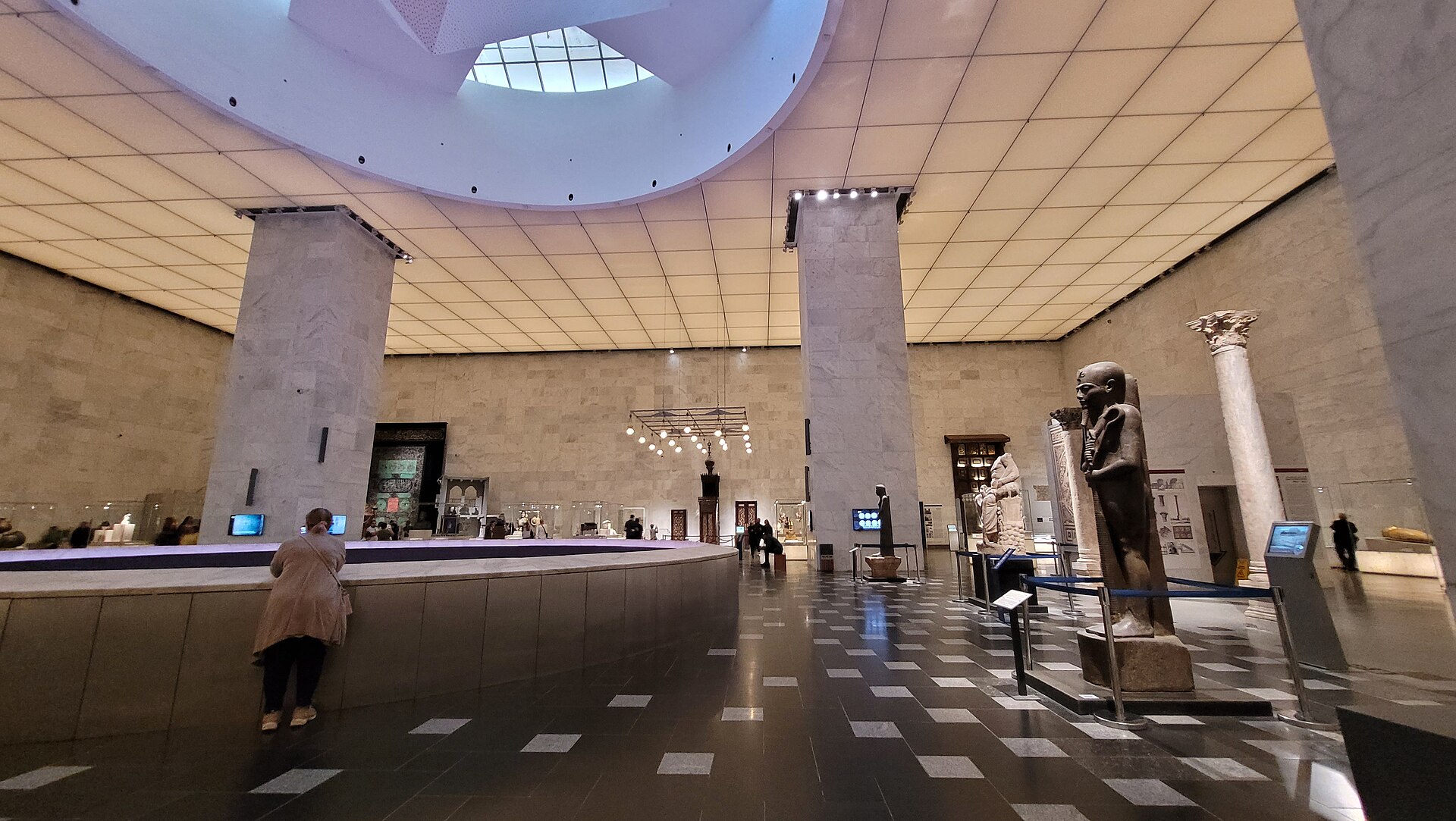
The National Museum of Egyptian Civilization (NMEC): From Prehistory to Modernity
The NMEC in Fustat is the only Egyptian institution telling the full national story — from prehistoric settlements to contemporary Egypt. Its Royal Mummies Hall, the 2021 Pharaohs' Golden Parade, and what makes its curatorial approach distinctive.
 Luxor
Luxor
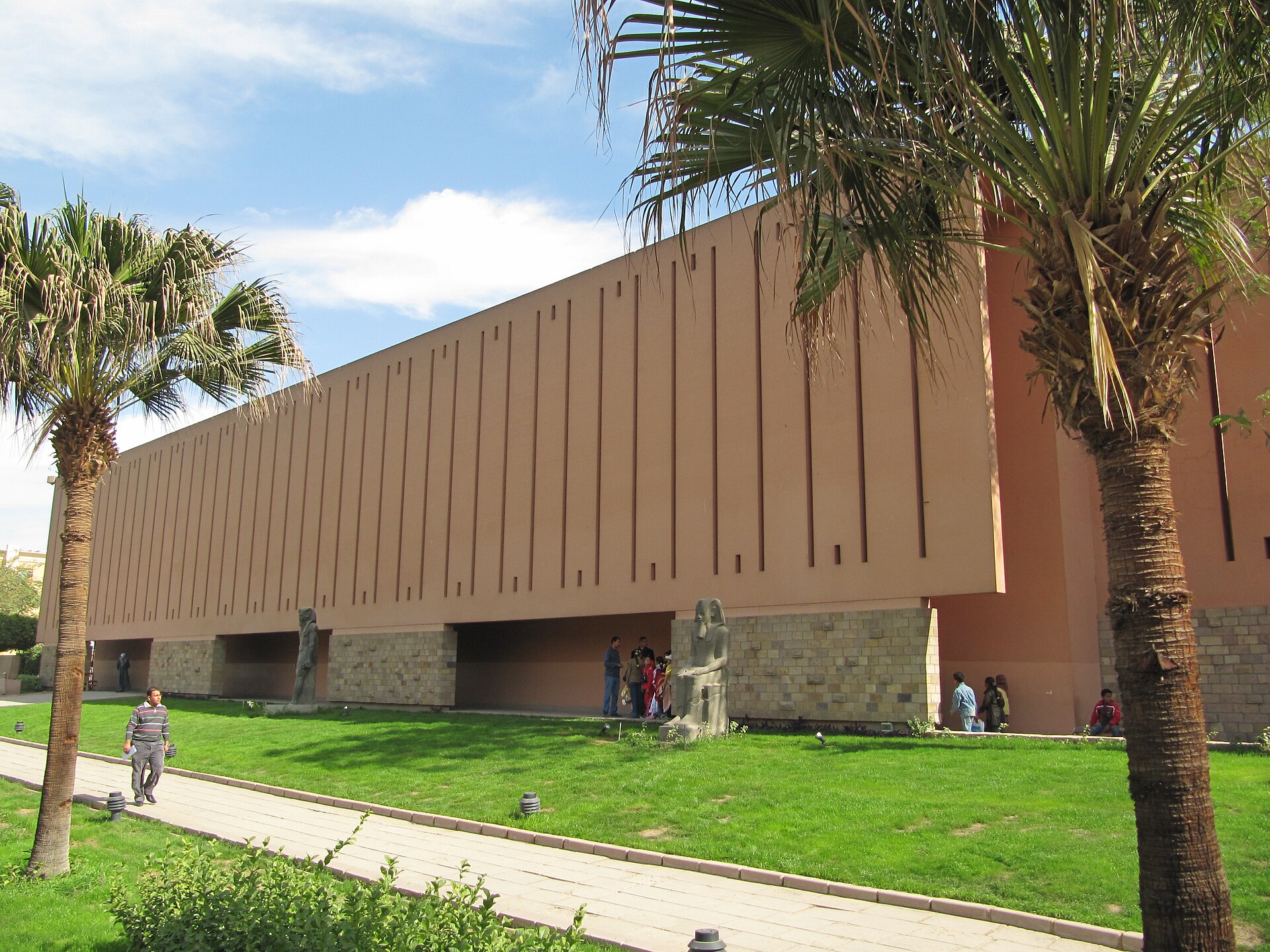
Luxor Museum: The Heart of Ancient Thebes
Opened in 1975 on the east bank of the Nile, the Luxor Museum is deliberately small and deliberately curated. A guide to its two royal mummies, the Karnak Cachette finds, and why many Egyptologists consider it the country's most elegant display.